

%20(1).jpg)
To choose the right MVP development partner, evaluate how a team helps you learn fastest with the least waste: their domain and technical expertise, their communication and delivery process, their pricing model, and the proof in their past projects. The wrong choice burns budget and time without producing the signal you need. The right one validates your riskiest assumptions, ships a lean product real users can try, and gives you a clear path to scale.
This guide is a practical framework for founders and product leaders selecting an MVP development partner in North America. It covers the criteria that separate strong partners from weak ones, the questions to ask, the red flags to watch for, and a simple scoring method you can use during vendor interviews. It applies across industries, from healthcare and fintech to retail, logistics, education, and SaaS. If you are still deciding between an agency or a freelancer, start there and come back to this framework once you have settled on a model.
What an MVP Development Partner Actually Does
An MVP development partner is a product engineering team that helps you build the smallest version of your product that can test your most important business assumption with real users. A capable partner does far more than write code to a brief. They help you clarify the problem, the users, and the jobs to be done. They map a testable scope and prioritize only the features you need to validate first. They build a thin slice of real value rather than a pile of vanity features. They instrument that slice with analytics and feedback loops so you learn from actual usage. And they ship on a timeline that supports your funding round, pilot, or board checkpoint.
If a partner can only explain how they build faster, and not how they help you learn faster, keep looking. Speed without learning is just expensive motion.
Criteria for Selecting a Reliable MVP Development Partner
These are the criteria for selecting a reliable software development partner for an MVP. Score each one during your evaluation, because a partner can be strong on technology yet weak on communication, and either gap can sink an early product.
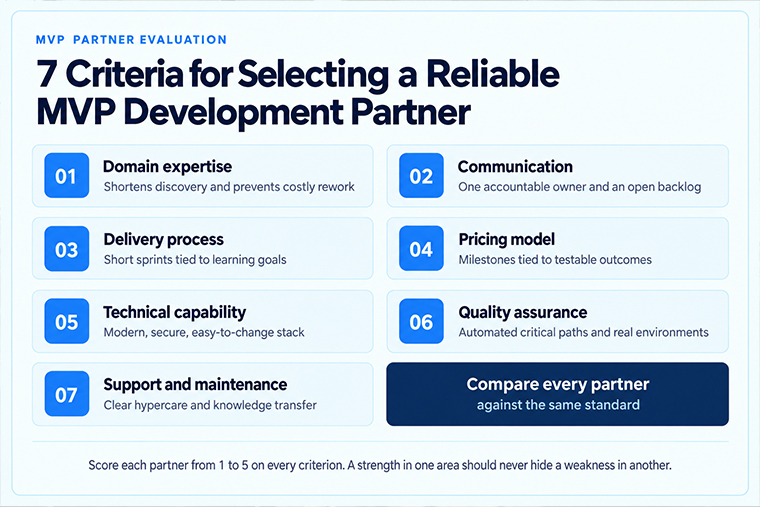
1. Domain expertise and industry knowledge
.jpg)
Domain fluency shortens discovery, prevents avoidable rework, and improves product decisions. In regulated or complex sectors, that nuance directly shapes user flows, data models, and controls. A strong partner can walk your workflow front to back, anticipate the constraints specific to your industry, and show reference work close to your problem rather than generic apps. Ask them to show two similar MVPs with goals, constraints, and results, and to explain what teams typically underestimate in your domain. Be wary of buzzwords with no specifics and any suggestion that hard requirements can be handled later.
- Communication and transparency
MVPs move quickly and assumptions shift, so clean communication is what keeps small misunderstandings from snowballing into scope creep. Look for one primary owner for day to day coordination, clear working agreements on response times and demo cadence, an open backlog you can see and reorder, and readable status updates that name what shipped, what is blocked, and what decision is needed. The red flags are email threads instead of a shared tracker, frequent last minute re-scopes, and learning about delays only after the deadline has passed.
- Project management and delivery process

For an MVP you need just enough process to keep momentum without bureaucratic drag. The patterns that work are short time boxed sprints with frequent demos, a backlog where each item ties to a learning goal rather than a feature, and a definition of done that includes instrumentation and basic documentation. Ask the partner to walk you through the first four weeks from kickoff to first demo, and how they keep MVP scope from ballooning. If everything is a priority and there is no plan for user testing, the process is not real.
- Pricing model and cost transparency
You are buying learning per dollar, not hours of coding, so the commercial model should align incentives to outcomes. Common models include time and materials, fixed scope milestone pricing, a standing squad for multi month roadmaps, and hybrids that fix the foundations while keeping experiments flexible. A reliable partner shares transparent rate cards and weekly burn reporting, ties milestones to testable outcomes, and keeps change control simple. Before you compare quotes, it helps to understand the true cost of building an MVP so you can tell a lean estimate from an incomplete one. Vague proposals with bulk line items, and budgets that leave out analytics or quality assurance, are warning signs.
- Technical capability and technology stack

An MVP should be simple to build, easy to change, and safe to replace if the market tells you to pivot. Look for fluency in a modern web or mobile stack, cloud maturity with staging environments and infrastructure as code, ready patterns for authentication and role based access, and data design that supports analytics from day one. Our guide to MVP tools and tech stack every founder should know is a useful reference when you compare what each partner proposes. Be cautious when everything is custom built with no proven building blocks, or when there is no continuous integration and no environment parity.
- Quality assurance and testing
In an MVP, quality is really about confidence that the next change will not break the last learning and that pilots will not stall on basic issues. A right sized approach balances unit, API, and smoke tests, automates the critical paths such as sign in and onboarding, and uses realistic test data that avoids real personal information. Ask how the partner structures quality assurance and testing across environments, and confirm there is a simple rollback plan. A plan to test manually for now with no path to automating critical paths is a red flag.
- Support and maintenance
After launch the real work begins, so confirm what happens next. Look for clear post launch support tiers with response times, bug triage rules, a steady release rhythm for improvements, and genuine knowledge transfer through runbooks and a handover session. Ask what the first 30 to 60 days of hypercare includes, how maintenance is separated from new feature work in billing, and what changes when you scale from a pilot to thousands of users. Support treated as an afterthought, with no documentation, is a sign of trouble later.
A Simple Scoring Matrix to Compare Partners
Turn the seven criteria into a lightweight rubric so your decision stays objective rather than swayed by the best sales deck. Score each partner from one to five on every criterion, weight the criteria that matter most for your product, and multiply score by weight to rank them. Keep short notes on each partner's clearest strength and biggest risk.
.jpeg)
The value of the matrix is not the exact number. It is the discipline of comparing every partner against the same standard and writing down why one scored higher than another.
How to Run a Fast, Low-Risk Selection Process
You can choose a partner in two to three weeks without cutting corners. The sequence below keeps the process short while still surfacing the differences that matter, and it works whether you are hiring locally or outsourcing MVP development.
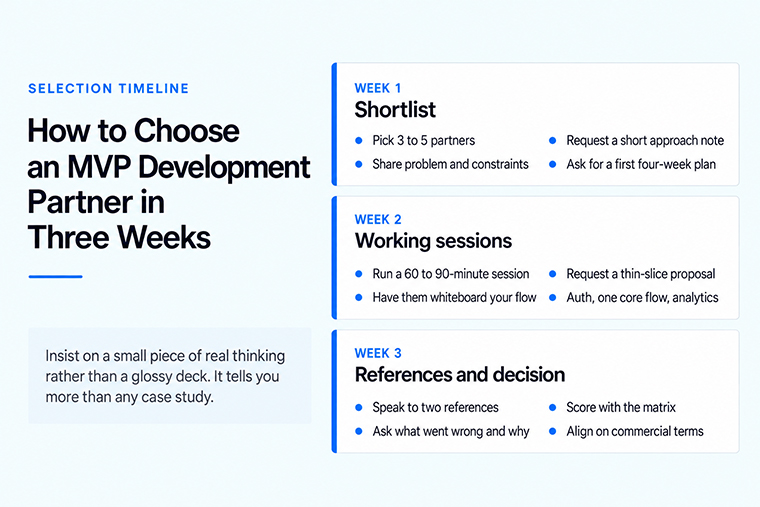
In the first week, shortlist three to five partners, share a focused problem statement and your key constraints, and ask each for a short approach note and a sample plan for the first four weeks. In the second week, run a 60 to 90 minute working session with each finalist and have them whiteboard your user flow, then request a thin slice proposal covering authentication, one core flow, analytics, basic testing, and a staging environment. In the third week, speak to two references and ask what went wrong on their project and how the partner handled it, then score everyone with the matrix and align on commercial terms.
Insisting on a small piece of real thinking, rather than a glossy deck, tells you more about a partner than any case study.
Choosing a Partner for Regulated and Complex Industries
Some products carry constraints that a general MVP playbook ignores, and the right partner treats those constraints as first class requirements rather than afterthoughts. In healthcare, that means safeguarding protected health information, meeting HIPAA obligations, and exchanging data with electronic health records, which makes interoperability essential to adoption. That is why our healthcare integration and EHR work starts with secure, standards based data exchange in the very first release, and why it is worth reviewing HIPAA compliant MVP builders if you are building in that space. In fintech, it means payment card security, banking integrations, and fraud controls from the first release. Education products touch student data rules such as FERPA, and any product serving Canadian users should account for privacy expectations under PIPEDA. Across all of these, ask a prospective partner which compliance frameworks they have actually implemented in production, not just discussed.
North America-Specific Considerations
If your pilots run in the United States or Canada, confirm working hour overlap for demos and support, and clarify on call coverage for launch windows. Check where data will live if residency matters, and confirm region scoped infrastructure and backups. It also helps to choose a technology stack aligned with the North American talent pool, so you can hire and support the product in house once the MVP proves itself. If you are still building a shortlist, our roundup of MVP development companies for startups in North America is a practical starting point. These details rarely appear in a proposal, but they shape how smooth the engagement feels once real users arrive.
Common Mistakes to Avoid
Most failed MVP engagements trace back to a small set of avoidable errors. We cover these in depth in our guide to common mistakes in MVP development, and the shortlist below is what to watch for while you are still choosing a partner.
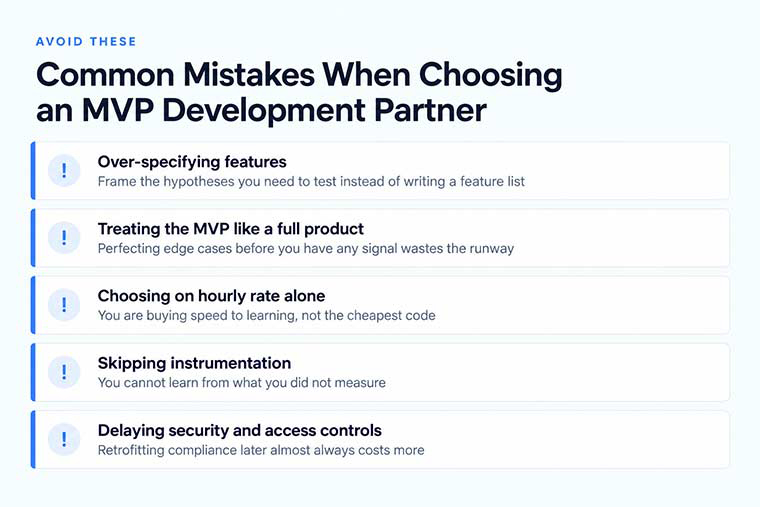
The most frequent mistake is over specifying features instead of framing the hypotheses you need to test. Close behind is treating the MVP like a full product by perfecting edge cases and chasing feature parity before you have any signal. Choosing a partner on hourly rate alone is another trap, because you are buying speed to learning rather than cheap code. Skipping instrumentation leaves you unable to learn from what you shipped, and delaying security and access controls almost always costs more to fix later than it would have to build correctly the first time.
Why Companies Choose Cabot for MVP Development
Cabot Technology Solutions is a product engineering partner that startups and established companies choose to turn an early idea into a working, validated MVP. Teams pick us for five reasons that map directly to the criteria above.
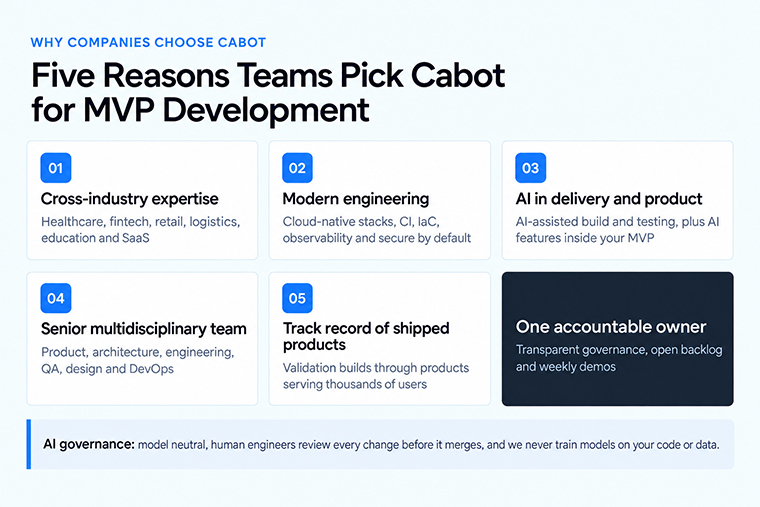
- Cross-industry expertise: We have built MVPs and full products across healthcare, fintech, retail, logistics, education, and SaaS, so we bring pattern recognition to your domain instead of learning it on your budget. That breadth means we anticipate the workflows, integrations, and constraints that slow less experienced teams down.
- Modern engineering and technology advancement: We work in modern, cloud native stacks with continuous integration, infrastructure as code, staging and production parity, observability, and secure engineering practices built in. The result is an MVP that is quick to build, easy to change, and ready to scale when the market rewards you.
- AI woven into delivery and product: We use AI across the delivery lifecycle to move faster, from AI assisted prototyping and code generation to automated test creation and code review, always with human engineers reviewing every change before it merges. Through our AI engineering practice we also build AI capabilities directly into MVPs when they create real value, including intelligent assistants, document and data extraction, predictive features, and integrations with leading language models. Our approach stays model neutral, and we never train models on your code or data.
- Senior, multidisciplinary team: Your engagement includes product management, solution architecture, full stack and mobile engineering, quality assurance, UX design, and DevOps, coordinated by a single owner who is accountable for outcomes. As the product grows you can extend your team with senior engineers rather than rebuilding the team from scratch.
- A track record of shipped products: Our portfolio spans early stage validation builds through products now serving thousands of users, delivered with transparent governance, open backlogs, weekly demos, and clear milestone definitions. [CONFIRM: add two or three named projects or anonymized outcome metrics, for example users onboarded, time to launch, or funding raised after the MVP, to strengthen this proof.]
If you are weighing an MVP build, our MVP development services team is glad to walk through sample plans and relevant projects so you can judge the fit against your own criteria.
Conclusion
Choosing the best MVP development partner is not about the flashiest deck or the lowest hourly rate. It is about selecting a team that helps you learn the fastest with the least waste, while respecting the realities of your domain, budget, and timeline. Focus your evaluation on domain fluency, clear communication and transparent governance, a right sized process, pricing aligned to learning milestones, technical choices that are simple and secure, quality practices that build confidence, and a support plan that keeps momentum after launch. Run a short, structured selection process built on real artifacts rather than promises, and use the scoring matrix to keep the decision honest.
Ready to build an MVP with a partner that treats it as a path to real signal? Talk to Cabot's team and we will share sample plans and projects to help you decide with confidence.